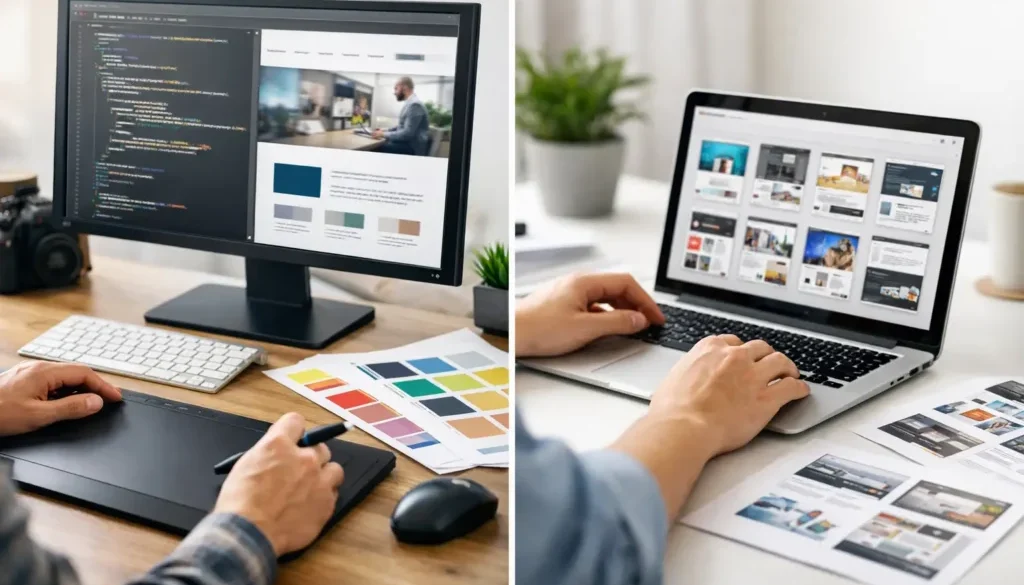
Custom Website vs Template Website – Which Fits?
A prospective customer lands on your website after searching for a local service, checks your home page on their mobile, then decides within moments whether to call, enquire or move on. That is why the custom website vs template website decision is not simply about appearance. It affects how clearly your business is presented, how easily customers can take action and how well your online presence can grow with you.
For many small and medium-sized businesses, a template website can look like a quick path to getting online. A custom website is designed around the way your business actually works: your services, ideal customers, locations, enquiry process and long-term visibility goals. Neither option is automatically right in every situation, but the differences matter once your website becomes a central part of generating business.
What a template website is designed to do
A template website uses a pre-built layout. You choose a design, replace the demo text and images, add your logo, then publish the site. Website builders and content management platforms offer templates for almost every industry, from trades and health services to restaurants and professional firms.
The main appeal is simplicity. If your business only needs a basic online introduction, has very little content and does not need a distinct lead-generation process, a template can provide a starting point. It may suit a short-term campaign, a new idea being tested or a business that only requires a simple digital brochure.
The limitation is that the site was made to suit a broad group of users, not your business. The structure, page hierarchy, conversion prompts and visual choices are all based on general assumptions. Once several competitors use similar templates, businesses can begin to look interchangeable.
Templates can also encourage businesses to work around the layout rather than build a website around customer needs. Important service details may be compressed into generic sections. Navigation may not reflect how people search for what you offer. Enquiry forms can be treated as an afterthought instead of a clear next step.
Custom website vs template website: the practical difference
A custom website begins with business requirements, not a pre-selected layout. The design and structure are planned to present your offer clearly, establish trust and guide visitors towards the actions that matter, whether that is making an enquiry, booking an appointment, calling your office or visiting your location.
For a local electrician, this could mean dedicated pages for the services people search for, clear service-area information, licence details, recent project imagery and mobile-first contact options. For an accountant, it may mean a more considered structure that explains specialist services, demonstrates expertise and makes an initial consultation feel straightforward. The site should support the customer journey for that particular business.
Custom design is not about adding unnecessary features or visual effects. It is about making deliberate choices. Page layouts can give priority to the information customers need first. Calls to action can appear where visitors are ready to act. Content can be arranged for clarity rather than forced into preset content blocks.
A well-built custom website also creates a stronger foundation for the digital services that support it. Search engine optimisation, local business listings, Google Business Profile activity, social media content and video all perform better when they direct people to relevant, professionally structured website pages. Your website remains the central place where interest becomes an enquiry.
Credibility is built in the details
Business owners often focus on whether a website looks modern. That matters, but credibility is more than a fashionable design. Customers notice whether the site feels relevant, clear and professionally maintained. They look for signs that you understand their needs and operate as a genuine, established business.
A custom site gives more room to show this evidence naturally. It can feature your process, qualifications, service areas, team, work examples, customer questions and the specific reasons people choose you. These are not decorative extras. They address the hesitation a visitor may feel before making contact.
Templates can accommodate some of this content, but their default layout may give every business the same visual rhythm. A custom approach allows the content to lead. A health provider may need a calm, reassuring path to booking. A building business may need strong project imagery and a detailed services section. A hospitality venue may need menus, functions and location information to be immediately accessible on mobile.
Visibility needs more than a published website
A website cannot support search visibility effectively if its pages are vague, thin or difficult for visitors to navigate. Search engines and AI-powered answer tools need clear information about what your business does, where you operate and why a page is relevant to a particular search.
Custom website planning makes room for this from the beginning. It can include a logical site structure, focused service pages, clear headings, helpful supporting content and strong local relevance where appropriate. This gives search engine optimisation and Artificial Intelligence Answer Engine Optimisation a more useful base to work from.
For businesses in Eltham and Melbourne’s north-east, local relevance can be particularly valuable. A visitor searching for a service nearby wants confidence that you serve their area and understand the local market. That information should be easy to find and genuinely useful, rather than repeated awkwardly across every page.
A template is not automatically invisible in search results. Good content, sound technical setup and ongoing optimisation can improve a template site’s performance. However, a customised structure makes it easier to create pages around real customer searches without being limited by generic page formats.
When a template may be enough
There are situations where a template is a reasonable choice. A business may be validating a new concept, promoting a single event or publishing a temporary information page. If there is no need for detailed service content, ongoing promotion or a tailored enquiry journey, a simple template can meet the immediate need.
The key is to be honest about the website’s role. If it is expected to represent your brand, compete in local search, reassure high-intent visitors and generate steady enquiries, it needs to do more than display a logo and a short description.
It is also worth considering who will manage the site over time. A template can appear easy to update until changes affect spacing, mobile display, menus or page consistency. Without a clear design system and professional guidance, quick edits can gradually weaken the presentation.
What to consider before choosing
Start with your customers, not the website platform. Think about what they need to know before they contact you, the questions that delay a decision and the action you want them to take. Then consider how your business plans to promote the site through search, local listings, social channels or video.
A custom website is generally the stronger choice when your services need explanation, your business relies on leads, you operate across multiple locations or you want to build a recognisable brand presence. It is also appropriate when your existing website no longer reflects the quality of your work or makes it difficult for customers to find the right information.
The right website should be easy for customers to use and easy for your business to build on. It should not force your services into someone else’s idea of what a business website ought to be.
NuDesign approaches website design as the foundation of a wider digital presence. A professionally planned custom site gives every supporting activity a more credible destination, from search visibility and business listings to social media and video content. More importantly, it gives customers a clear reason to take the next step when they find you.
Before choosing a template or custom build, look at the decision through your customer’s eyes. If your website needs to earn trust, explain what makes your business different and turn interest into genuine enquiries, it deserves to be designed around the work your business needs it to do.