Website Redesign vs New Website – Which Fits?
A website can look dated without being beyond repair. Equally, a website can look modern while still being difficult to manage, hard to find in search, or unclear about what the business actually does. The decision between a website redesign vs new website should not be based on appearance alone. It should be based on whether your current site can still support enquiries, credibility and long-term digital growth.
For many small and medium-sized businesses, the website is the centre of their online presence. Your Google Business Profile, social media activity, business listings, videos and search visibility all work harder when they lead people to a professional website that gives them a clear reason to contact you.
Website redesign vs new website: the core difference
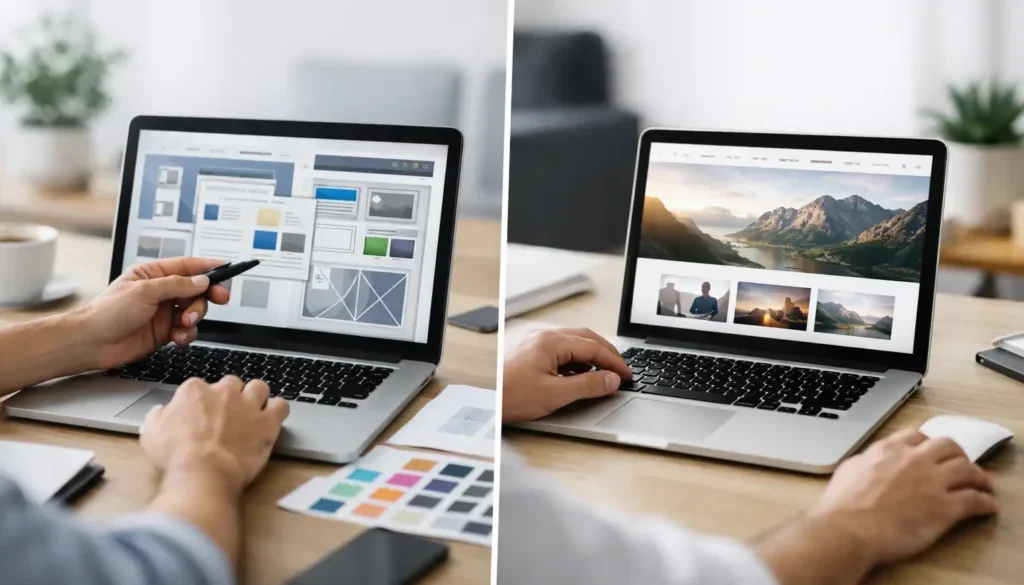
A website redesign improves an existing website. This may include a new visual style, clearer page layouts, updated content, improved mobile usability, stronger calls to action and better alignment with your current brand. The existing website structure, platform and content may remain partly in place.
A new website is built from the ground up. It gives your business the opportunity to rethink the structure, technology, content, user journey and purpose of every page. Existing pages and search visibility can still be reviewed and carried across where appropriate, but the new site is not limited by the weaknesses of the old one.
Neither option is automatically better. A redesign can be the right move when the foundations are sound. A new website is often the smarter choice when those foundations are holding the business back.
When a website redesign makes sense
A redesign is worth considering when your current website is technically reliable and contains useful content, but no longer reflects the quality or direction of your business. Perhaps your services have expanded, your branding has changed, or the site was built several years ago and now feels cluttered on mobile.
If customers can still find information easily, submit an enquiry without issues and move between pages without confusion, a redesign may provide the improvement you need. Updating the homepage, service pages, navigation, imagery and calls to action can make a significant difference to how professionally the business is perceived.
A redesign is also suitable when your existing website already has pages that perform well in search results. Those pages should not be removed casually. Refining their content, improving internal navigation and strengthening their relevance can protect existing visibility while making the overall site more effective.
For example, an Eltham trade business may have established service pages that are already attracting searches from nearby suburbs. If the site is functional but the presentation is dated, a strategic redesign can improve conversion without throwing away valuable search history.
Signs your website has a solid foundation
Your existing site may be suitable for a redesign if it loads reliably, works properly on mobile devices, uses a supported content management system and allows your team to update essential information. It should also have a logical page structure and no major security, accessibility or performance issues.
The key question is whether the website can be improved without working around constant technical limitations. If every change requires a workaround, the site may be telling you it is time for a fresh build.
When a new website is the better decision
A new website is generally the stronger option when the current site was built on outdated technology, is difficult to update, performs poorly on mobile, or has been patched together over many years. These problems are not always visible at first glance, but they can affect enquiries, search visibility and day-to-day management.
A replacement is also appropriate when the business itself has changed substantially. A business that began with one core service may now serve different customer groups, offer several specialist services or operate across a wider area. Trying to force a new business model into an old website structure often creates confusing navigation and weak messaging.
A new build allows you to start with the customer journey rather than old pages. What does a first-time visitor need to know? Which services should be most prominent? What proof builds trust? Where should customers make contact? These decisions are much easier when the website is planned properly from the beginning.
Common reasons businesses replace their website
Some issues are difficult to solve through a visual refresh alone. A new website is usually the right path when you are dealing with several of the following:
- The site is not mobile-friendly or is difficult to use on a phone.
- Important pages are slow, broken or no longer supported.
- The content is poorly organised and customers struggle to find services.
- Enquiry forms, tracking or integrations are unreliable.
- The site does not represent the business you are now building.
- Previous changes have created inconsistent layouts, duplicate pages or technical errors.
These are business issues, not merely design issues. If customers cannot quickly understand your offer or contact your team, the website is not doing its job.
Do not judge the decision by design alone
A sleek new homepage can create the impression that a redesign is enough. But website design is only one part of website performance. A well-built website must also have clear content, sensible page structure, strong mobile functionality and a straightforward path to enquiry.
The best decision comes from reviewing the whole site. Look at where visitors enter, which pages receive attention, whether people use mobile devices, how enquiries are generated and where visitors leave. Review the website from a customer’s perspective as well. Can they tell what you offer within a few seconds? Do they see evidence that you are credible? Is it obvious how to get in touch?
If the answer is no, identify why. A poor first impression may be resolved with a redesign. A confusing structure, failing technology and outdated content usually point towards a new website.
Protect search visibility during the change
Businesses often delay website work because they are concerned about losing Google rankings. That concern is reasonable, but it should not stop necessary improvements. The risk comes from replacing or removing pages without a proper migration plan, not from improving a website thoughtfully.
Before redesigning or rebuilding, document the pages that currently attract visitors and enquiries. Keep useful service content where it remains relevant, improve it where needed and redirect old page addresses to their closest new equivalent. A page that has earned visibility should be treated as an asset.
This is where website design and SEO need to work together. Search engine optimisation supports the website by helping the right pages be discovered. It cannot compensate for a poorly structured site or unclear service messaging. The website remains the foundation; SEO, business listings, social media and other visibility work should lead people back to it.
Plan around customer action, not just pages
Whether you choose a redesign or a new build, begin with the actions you want customers to take. For most local businesses, that may be making a phone call, submitting an enquiry form, requesting an appointment or visiting a physical location.
Each key page should support one of those actions. A service page should explain the service in plain language, address the questions customers are likely to have and provide a clear next step. An about page should establish credibility. Contact information should be easy to find, especially on mobile.
It also helps to review what supporting material will strengthen the site. Professional photography, short videos, customer testimonials, project examples and useful service information can all build confidence when they are placed with purpose. Adding more content simply to fill space rarely helps.
A practical way to make the decision
Start with an honest audit of your current website. Assess its technical condition, mobile experience, content, navigation, enquiry process and alignment with your current business goals. Then separate the problems into two groups: issues that can be improved within the existing site, and issues created by the existing site itself.
If the main problems are presentation, outdated messaging and minor usability gaps, a redesign may be enough. If the platform, structure and user experience are all working against you, a new website will create a far better foundation.
NuDesign helps businesses approach this decision with practical website design advice, rather than pushing a cosmetic fix where a stronger rebuild is needed. The focus should always be a professional website that makes it easier for customers to understand your business, trust it and get in touch.
The right choice is the one that gives your business a website you can confidently promote, update and build on as your next customers start looking for you online.